Patriot Graves
Southwest Missouri’s Revolutionary War Soldiers
Revolutionary War Soldiers known to have lived, received pensions, and buried in Southwest Missouri
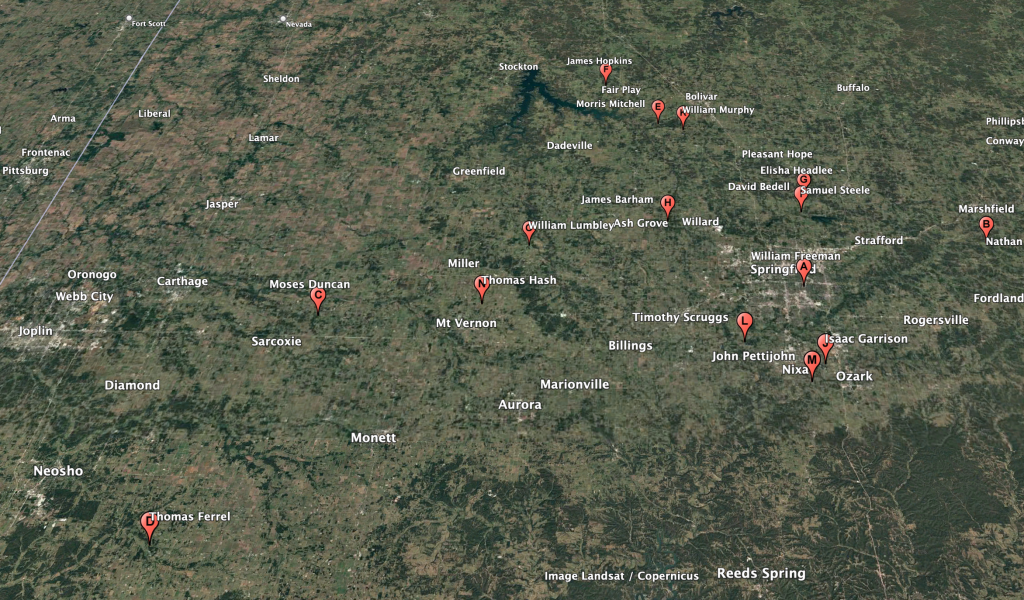
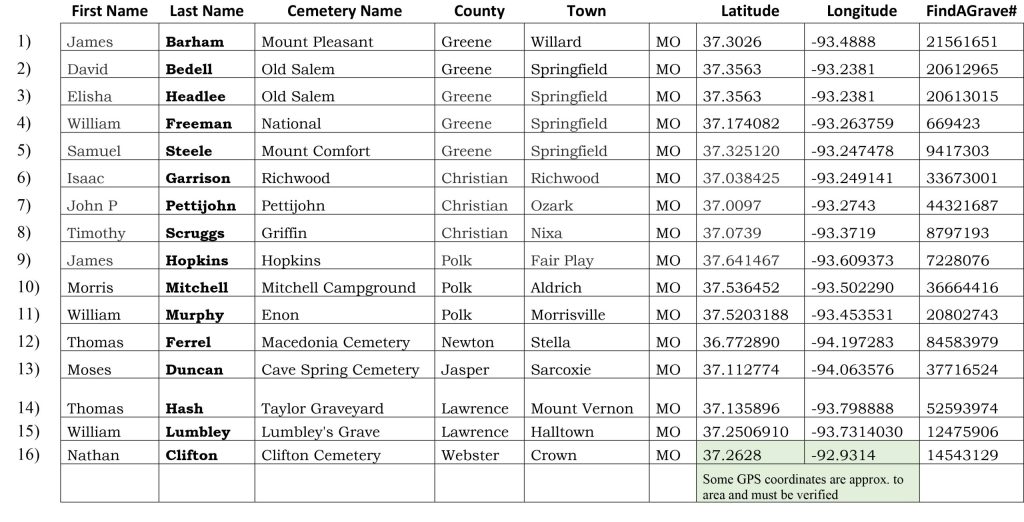
First of all, let me say this is not my research. I have merely edited information which is based on research of Graves Marked by DAR and SAR, Graves Marked by SAR and (Grave Marked by DAR) along with information from the book, First Ladies of Springfield, by Sally Lyons McAlear for the Rachel Donelson Chapter NSDAR of Springfield, and from the Website—maintained by Glenn Gohr—of Revolutionary War Soldiers in Southwest Missouri recognized by the Ozark Mountain Chapter SAR. Mr. Gohr lists 57 Missouri soldiers within the 100-mile radius of Springfield.
Twenty-three (23) of these soldiers lived, received their pensions, and were buried in Southwest Missouri and these are the soldiers we will talk about today—the reason being we have research to verify their service and lives.
Ten of these graves have been marked by the local chapters of the National Society of Daughters and Sons of the American Revolution in Christian, Greene, Jasper, Lawrence, and Polk counties. The DAR has marked an additional grave in Dallas County and SAR an additional grave in Newton County. In most cases, the DAR marking consisted of the local DAR chapter securing a government headstone and having it placed on the grave. The SAR marker is a bronze insignia which is placed on the grave.
Christian County recently erected a marker for John Pettijohn. The Isaac Garrison Chapter NSDAR placed a DAR Marker on this marker site on October 28, 2012.
Four of the graves in Greene County —those of James Barham, David Bedell, Elisha Headlee and Samuel Steele—have been recognized and marked as Greene County Historic Sites.
One grave—that of William Freeman—has been reinterred in National Cemetery in Springfield thanks to Miss Janie Hubble and the Rachel Donelson Chapter of DAR.
The Ozark Mountain Chapter SAR erected a historical marker at Springfield National Cemetery to commemorate all Revolutionary War Soldiers and the inscription reads as follows:
“During the Revolutionary War, almost 232,000 patriots served in the Continental Army, with 174,000 more serving in the Militia. Many more also served in civilian positions. This marker is to commemorate all those patriots who served our nation during the war. Thousands gave their lives, and all sacrificed so that we may live free. We must never forget them.”
The dedication of this marker was held on April 17, 1999. William Freeman is the only Revolutionary War Soldier buried in Springfield National Cemetery and each year there is a special wreath laying ceremony at his grave.
As for the soldiers themselves, five—James Hopkins, Samuel Steele, Timothy Scruggs, Isaac Garrison and William Freeman—served in the North Carolina Militia. Isaac Garrison was in the Battle of Brandywine, the Battle of Germantown, and at Valley Forge under Nathaniel Greene.
Moses Duncan served with South Carolina’s militia and was in the Battle of Charleston. David Bedell and Morris Mitchell were with the Pennsylvania Militia. Elisha Headlee served with the Morris County New Jersey Militia.
Timothy Scruggs, James Barham, Joseph Culton, Thomas Hash and William A. Lumley served with the Virginia Militia. James Barham, Isaac Garrison, and Timothy Scruggs all served under General Nathaniel Greene. James Barham was present at the surrender of Cornwallis at Yorktown. William Freeman and William A. Lumley were at the Battle of Guilford Courthouse, said to be the bloodiest battle of the Revolution. William Lumley was also at the Battle of Camden and the Battle of Ninety Six.
All of these soldiers eventually emigrated to Southwest Missouri in the early 1830s where they lived the last years of their lives and were buried. Some of the graves have been marked as Revolutionary War veterans, others have not.
By counties in Southwest Missouri, the four soldiers listed as receiving their Revolutionary War pensions in Barry County and with burial place unknown are Charles Dilday, Samuel Nelson, Augustin Sims, and Thomas Walker. There is no further information available on them at this time.
Three soldiers are buried in Christian County: Isaac Garrison, Timothy Scruggs. and John Pettijohn. Sr.
Dallas County: Andrew McPheeters
Greene County: Samuel Austin, James Barham, David Bedell, William Freeman, Elisha Headlee, Samuel Steele, and Thomas Thompson.
Jasper County: Joseph Culton, Moses Duncan, James Snowden, and Anthony Thomas.
Lawrence County: William Dilday, Thomas Hash, and William A. Lumley.
Newton County: Thomas Ferrell.
Polk County: James Hopkins. Morris Mitchell, and William Murphy.
Webster County: Nathan Clifton.
If I have missed anyone, I apologize. There is still a considerable amount of research which could be done on the Revolutionary War soldiers who came to Southwest Missouri where they received their pensions and bounty land and were buried.
LISTING OF SOLDIERS FROM GLENN GOHR WEBSITE FOR SAR: (John Pettijohn, Sr. added Oct 2012)
Barry County:
Charles Dilday, born in 1752, possibly in Virginia. He was living in Barry County in 1840 when he received a government pension for his Revolutionary War service and was 83 years old at that time. He was not shown on the 1850 census. His burial site is unknown. A William Dilday was living in Lawrence County at the same time and it is possible they were brothers.
Samuel Nelson, burial place unknown, Barry County, Mo.
Augustin Sims was born about 1762 and was living in 1840 at the age of 78 in Smith Township in Barry County where he received his Revolutionary War pension.
Thomas Walker was born about 1750 and in 1840 at age 90 was living in Smith Township in Barry County where he received his Revolutionary War pension.
Benton County:
Benjamin Proctor (1760-1850) burial site unknown.
Boone County:
William Wright (1763-1843) is buried in Hanson Graveyard near Roubidoux, Boone County, Mo. This William Wright married Rachel Sawyer and lived in Boone County, Mo.
Christian County:
Isaac Garrison (1732-1836) is listed in the DAR Patriot Index. He is buried in Richwood Cemetery two miles northwest of Ozark, Mo. Ozark Mountain Chapter SAR held a dedication service November 19, 1994 but an SAR insignia had been placed on his grave at an earlier time. The Isaac Garrison Chapter DAR of Ozark is named for this soldier.
Isaac Garrison was born in 1732 possibly in North Carolina. He is listed in the DAR Patriot Index as a recognized patriot in North Carolina during the Revolutionary War period. He is on several tax lists for Surry County, NC and also fought as a soldier for North Carolina first under either General Francis Nash or Col. Edward Buncombe. These men served in the Battle of Brandywine on September 11, 1777 and the Battle of Germantown October 4, 1777. Both Nash and Buncombe were mortally wounded at Germantown along with six other officers. It is believed their regiments combined to become the 2nd Pennsylvania Regiment. The Pennsylvania Archives record Isaac Garrison as a private in Joseph Howell’s Company, 2nd Pennsylvania Regiment from July 1, 1777 to August 1778 when it became Captain Peter Gosner’s Company. This company served at Valley Forge under General Nathaniel Greene. Garrison continued serving in this company until 1781.
After the war ended, Garrison was granted land in the Lick Creek area of Rowan and Surry County, NC. He sold the last of his NC property in 1791 and moved to Grayson County VA but moved back to Stokes County in 1795, then went to Hawkins County, eastern Tennessee. He left Hawkins County in 1832 at the age of 100 and came to Missouri with his sons Joseph, James and William. James and William settled in Greene County, MO, at a placer known as “The rich woods” on Finley Creek. This is where Richwood Cemetery got his name. He died in 1836 at the age of 104 at Rich Wood and is buried in the Richwood Cemetery.
According to family tradition Isaac Garrison knew George Washington in his youth and went with him on surveying trips. He is also said to have known Daniel Boone well and went with him on trips into the Kentucky Territory. It was a source of pride with Isaac that he had come from the same generation as George Washington and Daniel Boone and had outlived both of them.
John Pettijohn, Sr. (ca. 1758-after 1831) buried Pettijohn Cemetery near Ozark, Mo. Marker placed by the City of Ozark in 2010. NSDAR marker placed by Isaac Garrison Chapter in 2012.
John Pettijohn, Sr. (ca. 1758-after 1831) buried Pettijohn Cemetery near Ozark, Mo. was born in Sussex County, Delaware, January 5, 1764. He moved to and Colonel Guy Hamilton and later under Sergeant Samuel Miles in 1782 while living at Harrisburg, Virginia. Pettijohn produced the Reverend Thomas Casebolt, Joseph Price, William Friend, and Thomas Patterson and each of these men stated they had known the 72-year-old Pettijohn for a number of years. The pension was turned down on the basis that he had not served six months.
Pettijohn further stated that after the Revolution was successful, he moved to Monogahela County, Virginia, before taking his family westward to Gallila County, Ohio, in 1797. He farmed in Gallila County for twenty years, leaving Ohio in 1817-18. John P. Pettijohn, Sr., Joseph Price and Augustus Friend left Ohio in 1818 in a keelboat and came down the Ohio and Mississippi rivers to the White River in Arkansas and then to the James Fork in Missouri Territory. Pettijohn built a cabin about 8 miles south of what would become Springfield, but he sold this first claim to Thomas Patterson and moved further down the James which would become known as the Felix Rainey Farm.
After Missouri attained statehood in 1821, John Pettijohn Sr. moved to the confluence of the James River and Wilson Creek. However, this land had been ceded to the Delaware and the Pettijohns and other settlers had to give up their claims to the land and move. Mr. Pettijohn Sr. and his family returned to Ohio; however, they returned to their old home (sites) when the Delaware were removed to Kansas Territory in 1830-31. In their absence, the land had been occupied by the Delaware, but when the Pettijohns returned they found their former land was occupied by Joseph Porter. The Pettijohns moved further down the river to settle.
The Isaac Garrison Chapter NSDAR erected a bronze marker— honoring John Pettijohn’s Revolutionary War service— on the Pettijohn marker in Pettijohn Cemetery near Ozark, Mo., with a dedication of this marker scheduled for October 28, 2012.
John Petty — possibly buried Pettijohn Cemetery, father-in-law of John P. Pettijohn.
Timothy Scruggs (1761-1853) buried Griffin Cemetery 4 miles south of Battlefield, MO. Rachel Donelson Chapter DAR marked his grave with a government headstone and dedicated it on October 31, 1911. The Ozark Mountain Chapter SAR placed an SAR insignia marker and dedication on November 19, 1994.
Timothy Scruggs was born in 1761 or 1762 in Virginia. He enlisted in the Revolutionary War in 1779 and served to the end of the war. He first served 18 months under General Nathaniel Greene. He enlisted again in 1780 and served with the 1st Continental Dragoons in the North Carolina militia. He served as a private under Captain John Randolph of Lieutenant Colonel Henry Lee’s Legion and was discharged at Charleston, South Carolina. His father and brother both died at Valley Forge during the Revolutionary War.
After the war he moved to western Virginia that later became part of Tennessee. He claimed Bounty Land as the only heir of his father and brother but the other heirs took the case to Chancery Court in Richmond, VA and won. He applied for pension on July 29, 1831 at the age of 69 years while a resident of Buckingham County, VA. He came to Missouri in the spring of 1843, first to Calloway County where he had his pension transferred, stating he came with his children and he removed with them in order to be protected and cared for by them in his old age. Within a few years he moved to Campbell Township, Greene County. He died August 29, 1853 while living with his son, Timothy. He is buried at Griffin Cemetery at the top of a hillside overlooking a tributary of the James River that he loved. His great niece and her husband, Mary Scruggs and John Griffin, are also buried at the Cemetery which bears their name.
Dade County:
Research has revealed that William Penn, thought to have settled near Dadeville, was a veteran of the War of 1812, not the Revolutionary War.
Dallas County:
Andrew McPheeters (1761-1850) buried Crudgington Cemetery 1 mile south of Louisburg, Mo. His grave was marked by the Meyongo Chapter DAR on November 8, 1998.
Greene County:
Samuel Austin (1768-1854) buried Hazelwood Cemetery, Springfield, MO. He was born August 29, 1768, and was said to have fought with the Continental Army for a short time as a young boy. He and his wife, Catherine Paine (Payne) reared a family of nine children and all of them came to Greene County, MO. In about 1835—his son Greene Austin having come earlier with the Freeman family. Two of his sons married daughters of William Freeman, also a Revolutionary War Veteran and buried in National Cemetery. He died in 1854 and was buried in the family cemetery but was reinterred in March 1913 at Hazelwood Cemetery. He is thought to have received a pension for his war service and bounty land but this has not been verified to date by either the SAR or the DAR.
James Barham (1765-1865) buried Mt. Pleasant Cemetery north of Bois D’Arc, MO. Marked with a government headstone by the Rachel Donelson Chapter DAR in 1911, and a new headstone was placed in 1980s by a descendant which has a bronze replica of the Barham Crest on the reverse side. The Barham Coat of Arms includes bears and a stork or other bird on top of the helmet. The motto given is “Fortis et Patiens.” This Coat of Arms traces back to the knights who assassinated Thomas Becket. Ozark Mountain Chapter SAR placed marked with ceremony August 16, 2003. This grave has also been marked as a registered Greene County Historic Site.
James Barham was born in Southampton County VA in 1764 and entered the Virginia Militia on January 1, 1781 at the age of sixteen. He served in Whitehead’s Virginia Militia in General Nathaniel Greene’s division. He was present when Cornwallis surrendered to General Greene. He moved to North Carolina, living in Wake, Guilford, and Stokes counties. He moved to Kentucky in 1813 living in Logan, Calloway and Trigg counties. He had two wives and applied for pension on June 24, 1833 at age 69 living in Callaway County, KY. He moved to Greene County, MO and his pension was transferred on December 28, 1846 to Missouri. He applied for bounty land warrant in Greene County of January 8, 1865, in his 92nd year. He died at the home of his grandson, James Robinson, on Leeper Prairie, 15 miles west of Springfield on January 8, 1865 in his 101st year, one of five remaining Revolutionary War veterans, and was buried at Mt. Pleasant Cemetery north of Bois D’Arc, MO.
David Bedell (1761-1840) Buried Old Salem Cemetery ten miles north of Springfield, Mo. Marked with a government headstone by the Rachel Donelson Chapter DAR in 1911. Ozark Mountain Chapter SAR marked with a marker and joint service with Elisha Headlee (brothers-in-law) on May 16, 1992. This grave has also been marked as a registered Greene County Historic Site.
David Bedell enlisted under Captains George Gray and John Craig in what was called Gray’s Troop, Colonel Stephen Moylan’s Regiment of the 4th Continental Light Dragoons of the Pennsylvania Line. He served throughout the war, first as a drummer boy and later as a dragoon. After the war he married Ruth Fairchild whose father, Caleb Fairchild, and grandfather, Matthew Fairchild, had both fought in the American Revolution. Ruth’s sister, Mary “Mollie” Fairchild, married David’s boyhood friend, Elisha Headlee, also a Revolutionary War soldier, and they remained friends for the rest of their lives. David Bedell applied for his pension on October 27, 1828, while living in Burke County, NC. Besides the pension, he also received a bounty land warrant. In 1834, widowed, he moved with four of his sons to Greene County. Elisha Headlee (also a widower) and several Headlee children came to Greene County. David Bedell died in 1840 and was buried in Old Salem Cemetery.
William Freeman (1759-1839) buried in Springfield National Cemetery. Grave marked with a government headstone after reinterment by Rachel Donelson Chapter DAR in 1911. Ozark Mountain Chapter SAR placed marker in conjunction with the William Freeman CAR memorial service April 17, 1999. A ceremony in his honor is held each Memorial Day.
William Freeman was born October 26, 1759 in Bertie County, NC. He enlisted with the North Carolina Militia and served at various times during 1776, 1778 and 1781. He also served in Col. Abraham Shepherd’s Regiment, 10th Regiment of North Carolina. (Jackie Warfel note: There are no pension records to document he ever served as one of George Washington’s scouts). He served under the command of General Nathaniel Greene at the Battle of Guilford Courthouse, one of the bloodiest of the Revolutionary War.
He moved to Greene County, MO, in 1834 with his wife, Mary, and five of their living ten children. He died on January 28, 1839 and was buried on his farm. (See History of Discovering the Grave of RWS William Freeman). He was reinterred in National Cemetery on June 22, 1912.
Elisha Headlee (1760-1845) buried in Old Salem Cemetery 10 miles north of Springfield, MO. His grave was marked by Rachel Donelson Chapter DAR about 1911. Ozark Mountain Chapter SAR ordered a government headstone and had it erected in 1987 and held a joint memorial service with David Bedell (brothers-in-law) on May 16, 1992.
Elisha Headlee was born in Morris County, NJ, in 1760. He served as a private in the Morris County Militia while a lad of 16 or 17. After the war he married Mary “Mollie” Fairchild about 1787. In 1791 the Headlee’s moved to Burke County, NC where 10 more children were born. By 1823 Elisha moved to Maury County, TN. Where they were close friends and neighbors of Samuel and Jane Steele and their children. Samuel Steele was also a Revolutionary War soldier. Five of Elisha Headlee’s sons married five of Samuel Steele’s daughters. In the fall of 1836 Elisha, who was widowed, moved to Greene County, MO to join other families from Maury County TN who had settled in Greene County. Elisha died in 1840 at age 85 and is buried in Old Salem Cemetery next to his longtime friend and brother-in-law, David Bedell.
Samuel Steele (1762-1847) buried Mount Comfort Cemetery eight miles north of Springfield, Mo.
Marked with a government headstone by the Rachel Donelson Chapter DAR in 1911. Ozark Mountain Chapter SAR placed marker with dedication service May 17, 1997, although an SAR insignia had been placed earlier. This grave also has been marked as a registered Greene County Historic Site.
Samuel Steele was born in Pennsylvania in 1762 and moved to Burke County, NC with his parents as a child. He volunteered in the North Carolina Militia when he was a teenage boy. After the war he married and remained in Burke County for a number of years. The family moved to Maury County, TN and later to Greene County, Mo.
He is said to have been a Presbyterian in his youth but became a Methodist. Five of his grandsons shared by Samuel Steele and his long-time friend Elisha Headlee were Methodist ministers, all ordained at Mitchell’s Meeting House in Greene County, MO.
Samuel Steele died at age 85 in 1847 and was laid to rest in Mount Comfort Cemetery eight miles north of Springfield.
Thomas Thompson (1761-after 1840) burial place unknown. In 1840 at age 79 he was living with Malcolm MacDougal in Greene County, MO where he received a Revolutionary War pension.
Jasper County:
Joseph Culton (after 1766 — after 1842) burial place unknown.
Joseph Culton was born in 1766 at Augusta County, VA. He enlisted in the Revolutionary Army while living at Montgomery County, VA and served as a soldier in the Virginia Line. He continued to live in Montgomery County, VA for several years after the war. He moved to South Carolina and lived there about ten years and next lived at Gerrard and Knox Counties in Kentucky. In 1811 he moved to Floyd County, Indiana and in 1821 moved to Morgan County, Indiana, where he applied for his government pension. In June 1842 Joseph moved with his son, James (who spelled the last name Cullen) to Jasper County and Joseph died and was buried there, the exact date and burial unknown.
Moses Duncan (1764-1845) br 1980. Buried Cave Springs Cemetery, La Russell. The Rhoda Fairchild Chapter DAR of Carthage placed a DAR marker on his grave. There is also a SAR marker most likely placed by the Sgt. Ariel Nims Chapter SAR #1. A joint dedication service was held by the DAR and SAR in November 1980.
Moses Duncan was born in Newberry County, SC in 1764. He served in the South Carolina Militia with Roebuck’s Regiment, and was at the Battle of Charleston. He also served in the War of 1812 as a member of Captain James Tunnell’s Company of the East Tennessee Militia. He migrated to Sumner County, TN, in 1828 and joined a wagon train and migrated to Springfield, (Sangamon County, Illinois). In 1833 Moses and William Duncan moved to the Cave Spring Community in Jasper County, MO. Where he died in 1845.
Lawrence County:
William Dilday (?-ca.1841) exact burial place unknown except in an old cemetery. A Charles Dilday was living nearby in Barry County, Mo. About the same time William was living in Lawrence County. Possibly they were brothers.
Thomas Hash (1756-1848) buried Old Taylor Graveyard northeast of Mt. Vernon on the present Orin Carl Farm. During our nation’s Bicentennial, the Rhoda Fairchild Chapter DAR of Carthage placed a bronze marker and had a dedication on February 22, 1976. Ozark Mountain Chapter SAR placed an SAR insignia marker with dedication service on November 20, 1993.
Thomas Hash was born in the Shenandoah Valley of Virginia on February 13, 1756. He was listed as an ensign in Captain Enoch Osborn’s Company from Fincastle and Montgomery (now Grayson) Counties in Virginia on April 2, 1783. His time in the service was very short, for Cornwallis surrendered to George Washington at Yorktown on October 19, 1781. By 1800 Thomas had moved to Kentucky and moved several times after that. In 1832 he moved for the last time, with his son Phillip to what is now Lawrence County, MO when he was about 76 years old. He settled on land that is now Mount Vernon, MO where he died on December 25, 1848 at the age of 92 and was buried in what was known as the Robert B. Taylor family graveyard and now known as Old Taylor Graveyard.
William A. Lumley (1763-1843) buried on Turnback Creek 8 miles east of Miller. The Rhoda Fairchild Chapter DAR of Carthage placed a marked at his grave in 1928. The Ozark Mountain Chapter SAR placed an SAR insignia marked with dedication service on November 20, 1993.
William A. Lumley (or Lumbley) was born in 1763 in Virginia. When 17 years of age he enlisted as a soldier from Warren County, VA in 1780. He first served as a private in Captain Howell Myrick’s Company which was a part of the 1st regiment of the Virginia Line commanded by Colonel Richard Campbell, this regiment later placed under the command of Phillip Sansum which belonged to the battalion commanded by Major Thomas Edmund of Sussex County, VA. In his pension application he stated he was actively engaged in the Battle at Guilford Court House, NC; the Battle of Camden; the Siege of Ninety Six; the affair at Eutaw Springs; and many other skirmished. He was discharged in 1782 at Salisbury, NC.
He was awarded his pension on his application dated March 21, 1820 while a resident of McMinnville, Warren County, TN. From there he moved to Illinois and then to Arkansas and by 1837 was living in Barry County, MO where he purchased 80 acres of land on Turnback Creek. He built a crude pioneer home and later a water mill which was the first watermill to be built in northern Lawrence County. He operated this mill until his death on October 28, 1843 at the age of 80.
Newton County:
Thomas Ferrell (?-1841) buried Macedonia Cemetery on Highway 0 1 mile north of Stella. The grave was located by Robert G. Tucker of the Sgt. Ariel Nims Chapter SAR #1 which held a grave marking ceremony on November 11, 1983.
Phelps County:
Perry Ira Seaton, Sr. buried an old cemetery in the southwest part of the county. There is a village called Seaton in Phelps County which may be named for this man.
Polk County:
James Hopkins (1765-1849) buried Hopkins Family Cemetery 1-3/4 miles west of Fair Play. His grave was marked with a government headstone by the Rachel Donelson Chapter DAR of Springfield on September 6, 1931. The Matilda Polk Campbell Chapter DAR of Bolivar and the Ozark Mountain Chapter SAR of Springfield conducted a joint grave marking on May 1, 2006.
James Hopkins was born June 17, 1765, in Orange County, NC. He enlisted at age 16 as a private under Captain Parish, Major Humphrey and Colonel Thomas Farmer of the North Carolina Regiment and served during the greater part of the Revolutionary War and was honorably discharged for a disability received during the war. About 1800 the Hopkins family moved to Sumner County (now Wilson County) TN and in 1818 they moved to Jackson County, Illinois, but later back to Tennessee. They came to Greene County, MO in 1833 but went back to Illinois and to Tennessee. Then in 1835 they returned to Missouri and settled in Madison Township, Polk County. Elizabeth Hopkins, his wife, died in 1848 and was buried in Hopkins Cemetery.
Morris Mitchell (1762-1848) buried Mitchell’s Campground Cemetery near Aldrich.
Morris Mitchell served in the Pennsylvania Militia in Captain Ezekiel Rose’s Company, 5th Battalion of Washington County, PA during the Revolutionary conflict. He is reported to have lived in Maryland, Pennsylvania, Virginia and Knox, Blount and Roane Counties in Tennessee before coming to Missouri. He was a pioneer settler of Polk County and also became a Methodist Episcopal minister. He is buried in the old part of the cemetery at Mitchell’s Campground Cemetery in Polk County, but the exact grave is not known as the inscriptions have faded with time. His will was made on May 6, 1847 and probated on January 31, 1848 in Polk County.
William Murphy (1760-1850) buried Enon Cemetery near Morrisville. The Mary Wade Strother Chapter DAR of Salina, Kansas, and the Meyongo Chapter DAR of Buffalo, MO marked his grave with a DAR marker sometime about 1992.
According to records of the Meyongo Chapter DAR, William Murphy was born 31 March 1760 at Anson, NC. He enlisted in the Continental Army under the command of Colonel Wade of the North Carolina Militia where he served on four different occasions before being discharged in July 1782. He stated he was drafted for 3 months in 1781 and again in 1782. Following this he volunteered for 3 months. He served in the North Carolina Militia under Regiment Commander Col. Waid and his Company Commander was Captain Fair. In 1793 in Tennessee, William Murphy volunteered and served under Colonel Sevier during a Cherokee Indian uprising.
He removed to Greene County, TN 15 October 1786 and removed then to Jefferson County, TN, where he filed and received his pension on the Tennessee Pension Roll of 1835. By 1841, William was living with his guardian Samuel Box, his son-in-law, and drawing his pension in Missouri. He died on August 26, 1850 in Polk County, MO at the age of 90 years. He is buried in the Enon Cemetery southwest of Bolivar, Missouri and near Morrisville, MO.
Webster County:
Nathan Clifton (1758-1864) buried Clifton Cemetery 5 miles south of Marshfield.
Nathan Clifton was born in Raleigh, Wake County, NC on December 26, 1758. He enlisted at the age of 17 at Wake County, according to family records, and served in the Revolutionary War. He lived in Tennessee and Arkansas and finally settled down where Marshfield now stands in Webster County, MO. Nathan deeded an acre of ground for burial purposes and it is still in use today as Clifton Cemetery.
He was a skilled marksman and spent much of his time hunting wild game. He was over 100 years of age when a company of Union Soldiers on their way to the Battle of Wilson’s Creek passed near his farm. The soldiers had rested at the ford of the river and one of the group told the captain that a veteran of the Revolution lived on the next farm. The captain said, “Let’s have music.” They had a fife and a drum and so the company of men marched by with fife and drum playing and colors flying. The old veteran stood in his door yard at attention with his old flintlock musket and the Flag of the 13 colonies for which he had fought in his youth.
Nathan died in 1864 at the age of 105 (some records say 107) and was buried in the Clifton Cemetery with a gun salute and full military honors.
William Penn (see Dade County)
Unknown, buried in Ebenezer Cemetery near Marshfield. A Revolutionary War Soldier was reported to buried here, but the oldest visible markers are for people born after the Revolutionary War period; also, the history of Webster County by Watters lists some “soldiers” buried early on—but it is not clear if these are Revolutionary War or Civil War soldiers.
Sources:
McAlear, Sally Lyons, First Ladies of Springfield, A History of the Rachel Donelson Chapter, NSDAR, 2005, Dogwood Printing, Inc.
Gohr, Glenn, website of Sons of the American Revolution.
Greene County Archives, Springfield, Mo. Application for Pension by John Pettijohn (Pettyjohn) Va Series M805 Roll: 648 Image: 611 File: 0163
Revolutionary War Soldiers known to have lived, received pensions and be buried in Southwest Missouri — Program for Rachel Donelson Chapter NSDAR 2011